

Leveraging Location-Based Advertising Technology
Location-based advertising, also called geotargeting or geofencing, has changed the way local businesses can reach potential customers who are quite literally steps away from their storefront. Thinknear‘s technology not only has the ability to target audiences based on proximity, but also on context and historical-real world behaviors to allow for sharper audience segmentation, meaning marketers can tap into a user’s location not only in real-time but also up to months after they visit a certain geographic spot.
Google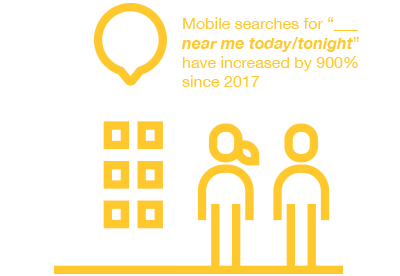 reports that mobile searches per user from hotel properties have grown 49% since 2017, with many including the phrase “near me.” Often people are looking either for a place to stay (“hotels near me” is a common term) or something to eat or drink (“food near me,” “breakfast near me,” “restaurants near me,” “bars near me”). Knowing this is just more reason to invest in location-based advertising.
If that isn’t enough to convince you, consider how many people are on the go while searching for something to do. Imagine eating lunch in a city you’ve never been to and want to explore what it has to offer. You pull out your smartphone and do a quick Google search” “things to do near me”. To your surprise an ad pops up for a local museum half a mile away so you decide to go. That’s the power of geotargeting.
Many of our clients like Lookout Mountain Attractions and Tupelo CVB are testaments to how location-based advertising technology can increase foot-in-the-door conversions.
Have questions or want to know more? Let’s talk!
Learn more about how we can help you adapt to the evolving marketing landscape and ramp up your efforts.
October 15, 2026
The future of travel marketing isn't about creating more content. It's about creating something AI can't reproduce without you. There is a fundamental problem emerging in travel marketing, and it has very little to do with whether you're using ChatGPT, Gemini, Claude, or whatever new AI product showed up while I was writing this sentence. The problem is that we have [...]
October 15, 2026

The future of destination marketing isn't simply about being discovered. It's about becoming a destination that travelers, and the AI systems helping them, can trust. Imagine planning the perfect family vacation. You want hiking trails with spectacular views, restaurants worth traveling for, beautiful beaches, and enough activities to entertain the kids. Maybe there's skiing in the winter, incredible shopping, and a quiet [...]
October 14, 2026
Earlier this week, I taught a graduate class on effective communication at the University of Michigan. I brought four stories I have used in keynotes and, after telling each one, broke down what made it work. Where did the audience become curious? Which detail carried the idea? What changed in the way they understood the subject? The question underneath all of [...]

 Ad Choices