

Google AI Mode Ads: What Brands Need to Know About Conversational Search
Google Just Changed the Rules on Paid Search. Here’s What That Actually Means.
Search advertising has operated on the same basic premise for two decades: you write the copy, set the bids, and control the message. Google announced last week that era is ending.
At Google Marketing Live, the company unveiled two new ad formats for AI Mode—Conversational Discovery and Highlighted Answers—that hand Gemini significant control over how your brand appears in paid placements. Not just when your ad shows up. What it says.
Gemini will now generate ad copy from your existing assets and website content, then append its own independent commentary sourced from reviews, third-party sites, and organic web content. That commentary is outside your control. It could include negative details about your brand. It could compare you unfavorably to a competitor—inside your own sponsored post.
Google confirmed both scenarios are possible.
This is a structural shift, not a feature update.
“Google is shifting Search from a keyword engine into an AI decision engine,” said Ryan Winfield, digital strategist at Advance Travel and Tourism. “The brands that win won’t rely on simply having the best bids, they’ll have the best answers, data, and customer experience, providing Google’s customers with the results that best reflect the original query.”
That reframe matters. Google’s customer is the searcher, not the advertiser. The new formats are engineered around that priority, and brands that treat paid search as a messaging control mechanism are going to have a hard time adjusting.
The paid/organic wall is coming down.
For years, brands have used paid search as a hedge, when organic visibility fell short, you bought your way back into the conversation. AI Mode’s new formats make that arbitrage significantly harder.
As Wpromote’s Valerie Dorer put it in coverage from Ad Age, your paid search success will now reflect your performance across YouTube, Reddit, reviews, PR, and every other signal Gemini draws from. You can’t compensate for a weak organic footprint with a higher bid.
Winfield sees the same dynamic from a strategic lens: “What this signals is that Google is moving away from short-tail and exact-match queries toward long, more nuanced prompts. The content around your products and services will matter now more than ever, as Google tries to marry the intent of the user with what you’re offering them.”
If your content ecosystem is thin, AI Mode will expose it, in your paid placements.
The competitive advantage is moving upstream.
The knee-jerk reaction from some advertisers will be concern about loss of control. That’s understandable. But the more useful frame is this: manual campaign optimization is becoming a commodity. The leverage has shifted.
“In the near future, the competitive advantage in paid media won’t come from who is making the most manual campaign tweaks,” Winfield said. “It’ll come from who can feed the AI the best signals, first-party data, direct conversion data, clearer positioning, better creative assets.”
This is where brands with mature data infrastructure and coherent content strategies pull away from the field. If you’ve been investing in customer data platforms, review generation, consistent brand voice, and substantive web content, you’re actually better positioned under this model than you were under the old one.
What to do now.
Three things deserve immediate attention.
First, audit your review ecosystem. Gemini is pulling from it to contextualize your ads. Reviews aren’t just reputation management anymore, they’re ad content.
Second, rethink your content investment. Long-form, intent-matched content isn’t just an SEO play. It’s the raw material Gemini uses to understand what you offer and how to present it in a conversational context.
Third, build your first-party data infrastructure. The brands that win in AI Mode will be the ones feeding the model the clearest signal about who their customers are and what converts.
AI Mode now has more than a billion monthly active users globally. This isn’t a beta test anymore. Google is building its advertising future around conversational search, and the formats announced last week are the clearest indication yet of what that future looks like for brands.
Learn more about how we can help you adapt to the evolving marketing landscape and ramp up your efforts.
October 22, 2026
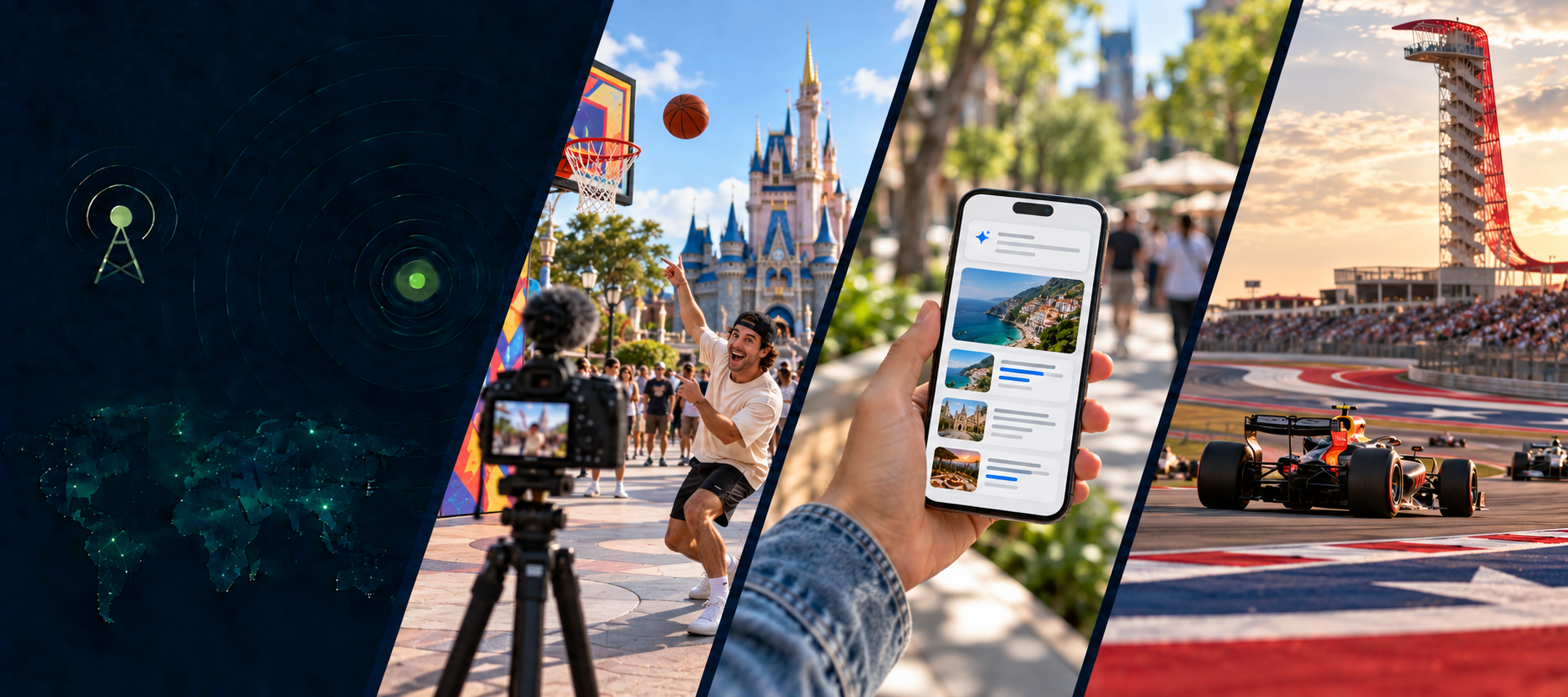
This week on Travel Signals, Disney is building around a creator’s established appeal. Google is making sources more visible inside AI answers. And Apple Maps is helping visitors find their way through one of Austin’s biggest weekends.
October 19, 2026

What a hometown concert, a marathon, and nearly 200,000 event attendees can teach us about what makes a destination worth visiting. On a moonlit Saturday evening, cool fall air chilled the 102,000 fans waiting for Twenty One Pilots to begin their largest and longest show to date. Suddenly, Ohio Stadium exploded in a wash of red as every screen and every [...]
October 15, 2026

The future of travel marketing isn't about creating more content. It's about creating something AI can't reproduce without you. There is a fundamental problem emerging in travel marketing, and it has very little to do with whether you're using ChatGPT, Gemini, Claude, or whatever new AI product showed up while I was writing this sentence. The problem is that we have [...]

 Ad Choices