

From Here To There
What a hometown concert, a marathon, and nearly 200,000 event attendees can teach us about what makes a destination worth visiting.
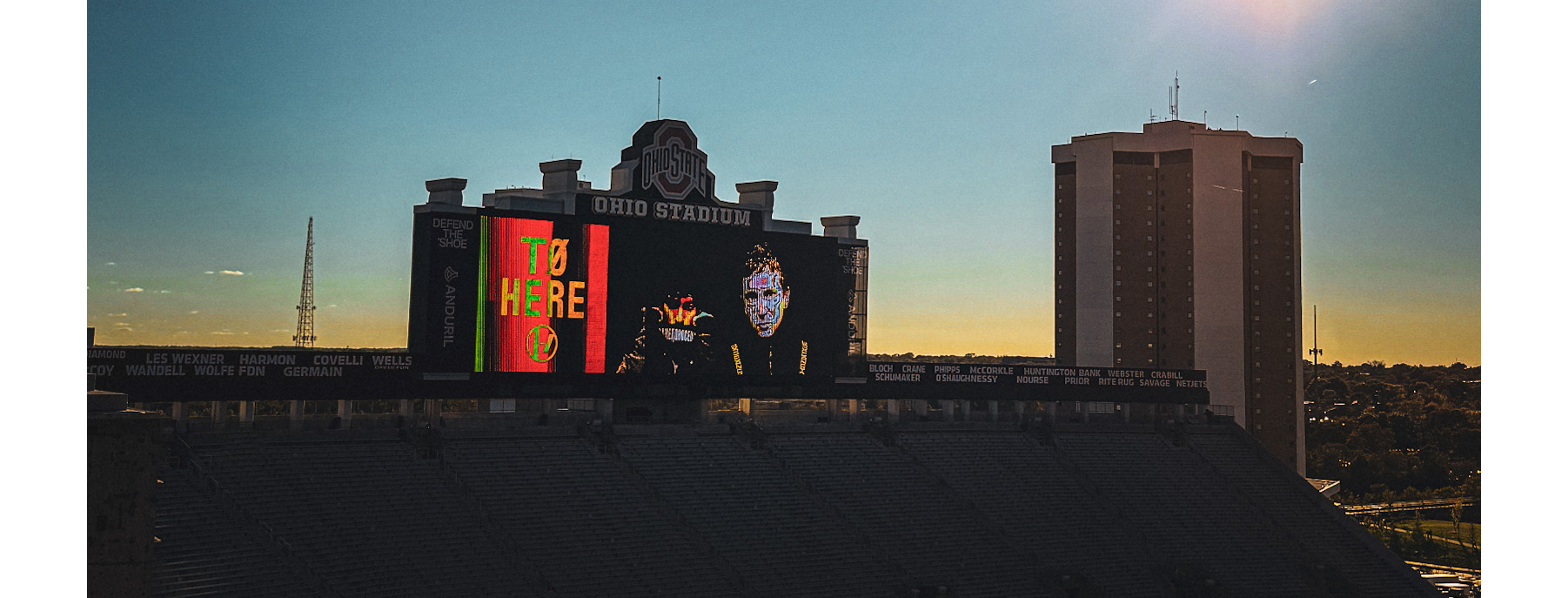
On a moonlit Saturday evening, cool fall air chilled the 102,000 fans waiting for Twenty One Pilots to begin their largest and longest show to date.
Suddenly, Ohio Stadium exploded in a wash of red as every screen and every bracelet adorning those fans ignited. Tyler Joseph, lead singer of the band, ascended a secondary stage as nearly every eye in the stadium remained locked on the main stage.
As the drone of the explosion faded, the chords of “Goner” began, faint and unmistakable.
We are starting here?
For the next three hours, Twenty One Pilots would deliver a 38-song performance complete with pyrotechnics, a drone show, an elaborate fictional sports broadcast, and a performance with the Ohio State University Marching Band.
But the thing that made this show remarkable wasn’t the production. It was Columbus.
I first saw this band in October of 2013 when they were touring with Vessel. It was so early in their career that I was able to let one of my college students, who was from Columbus, interview them for a school project.
I remember telling my friend Julian that they would never play a place that small again.
They didn’t.
Saturday night was the culmination of 17 years of hard work, tours, and a vision. And the fact that it happened in the city where Tyler Joseph and Josh Dun built their careers made the performance something different from another stop on a national tour.
They weren’t just playing a concert. They were coming home.
And 102,000 people wanted to be part of that homecoming.
What happens when a city becomes the story?
On Sunday morning, just hours after the lights went dark at Ohio Stadium, thousands of runners took to the streets for the Nationwide Children’s Hospital Columbus Marathon.
The marathon and half marathon brought another massive audience to the city, with more than 15,000 participants and an estimated 100,000 spectators expected along the course.
Across the two events, Columbus was looking at well over 200,000 event attendances in a single weekend, though that doesn’t necessarily mean 200,000 individual visitors.
Think about that for a moment.
Two enormous events, two entirely different audiences, and thousands of people arriving in Columbus for experiences they couldn’t have anywhere else.
And there’s an interesting challenge in all of this.
Columbus is the largest city in the United States without passenger rail service. It has a public bus system, but no subway, light rail, commuter rail, or Amtrak connection.
Moving that many people around a city without rail transportation is no small task.
For destination marketers, this is where the conversation becomes interesting. Because getting someone excited enough to visit is only part of the work. Getting them from here to there, quite literally, is part of the experience, too.
The traffic, the parking, the restaurants, the hotels, the walk to the stadium, and the morning after all become pieces of the story people tell about a place.
And those pieces matter.
You can’t manufacture belonging
For me, one of the most remarkable parts of Saturday wasn’t on the stage.
It was the five women sitting behind me who had grown up in Columbus and had seen Twenty One Pilots play venues even smaller than the one where I first saw them.
These women had joined what might be described as the religion of Twenty One Pilots. Watching them experience this hometown performance was almost as entertaining as watching the band.
My 10-year-old son was there, too. He knows the story of Clancy and Josh as the Torchbearer, the elaborate mythology the band has created over the years.
He had the time of his life.
And somewhere in that stadium were tens of thousands of other people carrying their own versions of those stories.
This is something destinations spend enormous amounts of time and money trying to create.
A sense of belonging.
But Columbus didn’t have to invent a connection between Twenty One Pilots and the city. That connection already existed. The band had spent years making Columbus part of its identity, and the audience had spent years becoming part of that story.
The destination isn’t a backdrop. It was a character.
There’s a distinction here worth thinking about.
We spend a lot of time in tourism marketing telling people what they can do when they arrive. We show them the restaurants, attractions, hotels, and experiences.
All important.
But sometimes the most powerful reason someone chooses a destination isn’t what they can do there.
It’s what that place means to them.
The experience travels home
I have been fortunate enough to see some remarkable concerts in my life.
Styx at the Chicago Theater, Pearl Jam’s first performance at Wrigley Field. Rage Against the Machine at the Roseland Ballroom. Alice in Chains opening for Van Halen (what a time).
Saturday’s show belongs alongside those memories.
But what I will remember most isn’t necessarily a song or the spectacular production. It’s the feeling of being in Columbus with my son, watching a band I first saw in a tiny venue become something almost impossible to comprehend.
I am still sitting here on Monday morning trying to turn the experience into a cohesive story.
And that might be the most valuable lesson for anyone working in travel and tourism.
The trip doesn’t end when someone checks out of a hotel, crosses the finish line, or leaves a stadium.
It keeps going.
In conversations with friends. In the videos people share. In the stories they tell their families. In the reasons they choose to return.
Those experiences become part of the destination’s identity, often told by people who have no professional connection to the tourism industry.
Think about how someone discovers a destination today. They might start with a question asked of an AI assistant, a video surfaced in their social feed, or a recommendation from someone they trust.
The stories visitors bring home become part of what future travelers find, believe, and eventually act on.
That’s an enormous opportunity for destinations willing to think beyond simply promoting attractions.
The goal isn’t just to get people to visit. It’s to give them something worth remembering and sharing.
From here to there
At the end of every show, Tyler Joseph says the same thing:
“We are Twenty One Pilots, and so are you.”
I’ve heard him say it for years. But standing in Ohio Stadium on Saturday night, with my son beside me and a city celebrating two of its own, I finally understood what he meant.
We weren’t just watching the story.
We were part of it.
And maybe that’s the thing great destinations understand better than anyone.
People arrive as visitors, but the best experiences give them some small sense that they belong.
I came to Columbus for a concert.
I left with a story I’ll carry for the rest of my life.
That’s a pretty remarkable thing for a destination to give someone.
Learn more about how we can help you adapt to the evolving marketing landscape and ramp up your efforts.
October 19, 2026
What a hometown concert, a marathon, and nearly 200,000 event attendees can teach us about what makes a destination worth visiting. On a moonlit Saturday evening, cool fall air chilled the 102,000 fans waiting for Twenty One Pilots to begin their largest and longest show to date. Suddenly, Ohio Stadium exploded in a wash of red as every screen and every [...]
October 15, 2026

The future of travel marketing isn't about creating more content. It's about creating something AI can't reproduce without you. There is a fundamental problem emerging in travel marketing, and it has very little to do with whether you're using ChatGPT, Gemini, Claude, or whatever new AI product showed up while I was writing this sentence. The problem is that we have [...]
October 15, 2026

The future of destination marketing isn't simply about being discovered. It's about becoming a destination that travelers, and the AI systems helping them, can trust. Imagine planning the perfect family vacation. You want hiking trails with spectacular views, restaurants worth traveling for, beautiful beaches, and enough activities to entertain the kids. Maybe there's skiing in the winter, incredible shopping, and a quiet [...]

 Ad Choices