

Who Took That? Photography in the Age of AI
For most of the internet’s history, a photograph arrived online with a strange kind of authority.
If you saw it, you assumed someone had taken it. A camera pointed at the world. Light hit a sensor. A moment froze in time.
Photography had a kind of built‑in credibility. Not perfect truth, photos can lie, of course, but at least there was an implied chain of reality: someone was there.
Then generative AI showed up and politely smashed that assumption.
Today an image can appear online that looks exactly like a photograph, but it may have never existed in the physical world. No camera. No location. No photographer.
Which leads to a deceptively simple question that is about to become one of the most important questions on the internet:
Who took that?
Not where did you find it.
Not who posted it.
But who actually captured the moment.
Because increasingly, the difference between human‑captured images and synthetic ones will matter.
The Missing Chain of Custody
In the art world, provenance is everything.
If a museum buys a painting, it doesn’t just hang it on the wall and hope for the best. There is a documented chain of ownership and authentication: who created the piece, who owned it, how it moved through the world.
Digital media never really developed that system.
Once an image is uploaded online it becomes infinitely copyable. Screenshots, reposts, compression, cropping—every step strips away metadata. Within a few hours of circulation, the original source is often impossible to trace.
That worked fine when images mostly came from cameras.
But now the internet is filling with pictures that look like photographs but were generated by machines. The result is an authenticity crisis. Not because people suddenly started lying, people have always lied, but because the cost of creating convincing visual fiction dropped to zero.
So the question becomes: how do we rebuild trust in images?
Signing Reality
One promising answer is surprisingly simple.
What if cameras signed photographs at the moment they were taken?
Imagine pressing the shutter and your camera creates a cryptographic signature attached to the file. That signature acts like a digital fingerprint. It proves the image originated from a specific device at a specific time.
From there, every edit could be recorded:
Captured → Cropped → Color corrected → Published
Instead of a static image file, the photograph becomes something closer to software with a version history. Anyone viewing it could inspect the lineage and see how the image evolved.
Several companies are already experimenting with this idea through standards like Content Credentials (C2PA), a system supported by organizations including Adobe, Microsoft, and major newsrooms. The goal is to embed verifiable metadata directly into images that records where they came from and what happened to them along the way.
Some camera manufacturers are beginning to explore hardware support as well, allowing cameras to cryptographically sign photos at capture.
The idea is simple but powerful: make authenticity part of the file itself.
Blockchain, Cameras, and the Ledger of Reality
Earlier experiments explored using blockchain as a public registry for image fingerprints. The concept was that when a photo was taken, its unique hash could be recorded on a distributed ledger. Anyone could later verify that the image existed at a particular time and hadn’t been altered.
In practice, the industry is leaning more toward embedded cryptographic credentials than full blockchain systems. But the underlying philosophy remains the same: create a tamper‑evident trail that follows the image through its life.
Think of it as Git for photography.
The camera makes the first commit.
Editors make additional commits.
The final published image carries the history.
Authentic Images in an AI World
None of this solves every problem. A signed photograph can still depict something misleading. A staged event photographed honestly is still a staged event.
Provenance proves traceability, not truth.
But it does restore something important: accountability.
If a photograph carries a verifiable chain of origin, you know someone stood behind the camera. Someone pressed the shutter. Someone documented the moment.
In an internet increasingly filled with synthetic media, that distinction becomes meaningful.
We may soon see a quiet shift online where images fall into three broad categories:
Authentic photographs with verifiable capture
AI‑generated images that disclose their origin
Everything else—the anonymous, remixable chaos of the internet
The first category may become especially valuable in journalism, marketing, and storytelling.
Because in a world where anything can be generated instantly, evidence becomes scarce.
The Return of the Photographer
Photography once revolutionized truth because it allowed machines to capture reality directly.
Artificial intelligence broke that assumption by allowing machines to invent reality just as easily.
Now the next phase of the internet may involve rebuilding the missing layer between those two worlds: systems that can verify when a machine actually saw something.
And when that moment comes, the most important question about an image may no longer be whether it looks real.
It will be much simpler.
Who took that?
Learn more about how we can help you adapt to the evolving marketing landscape and ramp up your efforts.
August 28, 2026
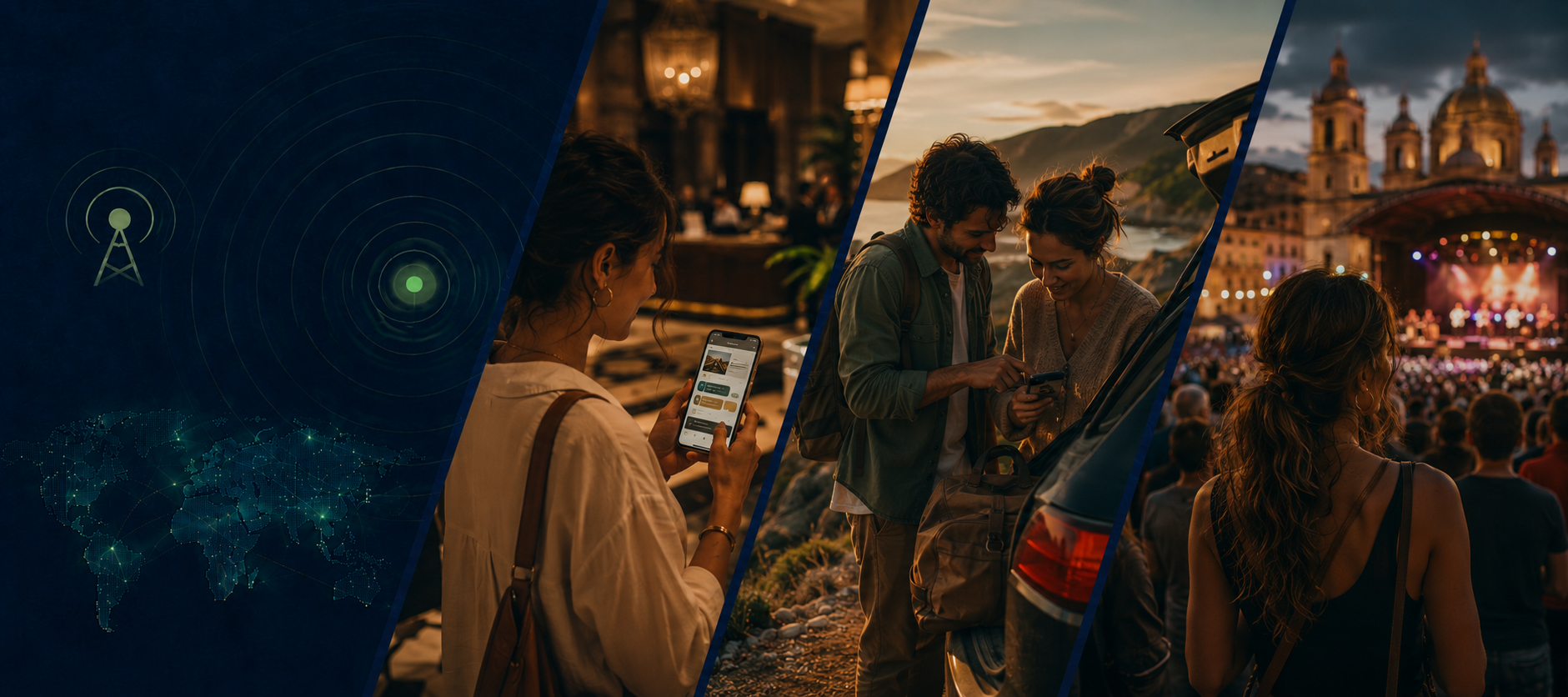
Travel Signals often looks beyond the travel industry for shifts that could reshape how people discover, choose and experience places. This time, the clearest signals are coming from inside travel itself. Across technology, traveler behavior and live events, the path from inspiration to arrival is becoming shorter and more intent-driven. Here are three signals we’re watching and what they could mean for travel marketers.
August 20, 2026

Brands are beginning to celebrate AI visibility when the more important question is whether AI is building the case for them—or against them. Marketing is beginning to make a familiar mistake. We are taking a new form of customer behavior and measuring it with an old model. Search visibility was largely positional: Did we appear, and where did we rank? As customers [...]
August 18, 2026

As we move through the second half of 2026, one travel trend is worth paying attention to: milestone moments are giving people a reason to get away. And for destination marketers, the opportunity may extend well beyond this year.

 Ad Choices