

We’re All Becoming Gamers: A Better Way to Learn and Use AI
Reid Hoffman has a LinkedIn newsletter called “Long Reads,” which might be one of the best newsletter titles on the platform. In a recent issue, he talks about a product called Replit, a tool that helps people code and build programs using AI. But the product itself isn’t the most interesting part of the piece.
It’s worth paying attention to is his framing: the best way to get better at using AI is to treat it like a game. In fact, the piece is titled “We’re All Becoming Gamers.”

When I was younger, one of my favorite games was Castlevania. It was a side‑scroller, which meant you could really only move in one direction. Marketing used to feel a lot like that too. From 1986 to 2026, there was a fairly linear playbook. You picked a channel, pushed a message, measured what you could, and moved on.
A lot has changed since then, and that can feel overwhelming, unless you reframe it.
Hoffman’s theory is that we’re now in a moment where we can build software designed for us. But the natural question is: where do you even start? To explain this, he uses Minecraft as an illustration.
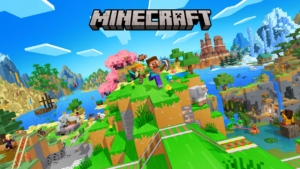
Minecraft acts as a blank canvas, It doesn’t hand you a path or a solution. You decide what you want to build. If you create a tool and it doesn’t solve your problem, you build another one. Feedback is fast. There is no perfect solution, just iteration.
That’s exactly how AI works.
There is no perfect prompt that magically “solves marketing.”
I’ve always loved games, digital or otherwise, and adopting a gamer’s mindset is how I approached AI the moment I started using ChatGPT November of 2022. Over time, I’ve come to think about it as a simple four‑step process.
-
Set the rules. Make sure your use of AI serves the humans you’re trying to impact. Constraints aren’t limitations — they’re game mechanics.
-
Pick a problem. What are you actually trying to solve? If you started a quest without clear gear or direction, you’d fail almost immediately. Clarity matters.
-
Pick a tool. This is where the fun starts. If one tool doesn’t work, you try another. When you frame problem‑solving as a quest, it removes a lot of unnecessary stress.
-
Learn from failure. Playing in the AI space gives you fast feedback. Failure isn’t a setback; it’s part of leveling up. As a bonus, your communication improves as you get better at prompting.
This approach isn’t that different from Steve Jobs’ philosophy of starting with the consumer and building the technology towards the audience not the other way around.
One final bonus tip: do as much of this in voice chat as you can. You’ll quickly find that voice prompting feels more natural, more conversational, and often more effective allowing you to get better at prompting – faster.
AI isn’t something to master all at once. It’s something you play with, experiment with, and get better at over time.
Just like a game.
Learn more about how we can help you adapt to the evolving marketing landscape and ramp up your efforts.
September 14, 2026

AI is reshaping travel marketing, from traveler discovery and non-commodity content to better prompts, paid AI advertising and emerging ChatGPT traffic.
September 11, 2026

Travel Signals: Hospitality Gets Human, Wellness Rejects Optimization and Algorithms Become Optional
Travel Signals looks beyond the travel industry for shifts that could reshape how people discover, choose and experience places. This week, the clearest signals are coming from fast food, wellness and social media. Across all three, consumers are reconsidering the role technology and optimization should play in their lives.
September 11, 2026

At a recent series of concerts, Fred again.. asked fans to cover their phone cameras with stickers and stay in the moment. Afterward, he gave them access to a Dropbox filled with professional photos and videos from the shows. It was a smart exchange: give the experience your full attention now, and you can keep the memory later.

 Ad Choices